
01The problem
Every client had a printed Medication Administration Sign Off Record. Support workers filled it in by hand, and a missed dose was a blank box with no reason attached to it.
Off-site support workers recorded their own timesheets manually, including travel time and kilometres driven between clients. Payroll summaries and client time reports were assembled by hand every pay period from those sheets.
In-house and outreach staff needed different calendars with different visibility rules. Outreach workers were not to see each other’s schedules. Any change to a published schedule had to be documented with a reason, because this is a regulated setting and an undocumented change is a problem.
02What was built
The Medication Administration Record, online
Each client’s medications pre-populate their own MAR from the client record, so the form matches the person rather than being a generic sheet. A dose that is not given is recorded with a reason instead of leaving a gap, and the record exports for review.
Two calendars, two sets of rules
Outreach staff see only their own schedule. In-house staff see the full team calendar. Only administrators can make changes, and every change carries a reason that notifies the administrators.
Timesheets that match how people actually work
In-house hours pull from the calendar. Off-site staff submit actual time in, time out, travel time and kilometres against their scheduled work, with a reminder when the previous day is missing. Expenses attach receipts, and shopping claims go through an approve or reject step.
Reports that export instead of being assembled
Client time and payroll summary reports generate from the recorded data and export to CSV, replacing the manual compilation that used to happen every pay period.
Built for a regulated setting
Two factor authentication on every login, role separation between administrators and staff, and an audit log recording changes with the reason attached.
03The outcome
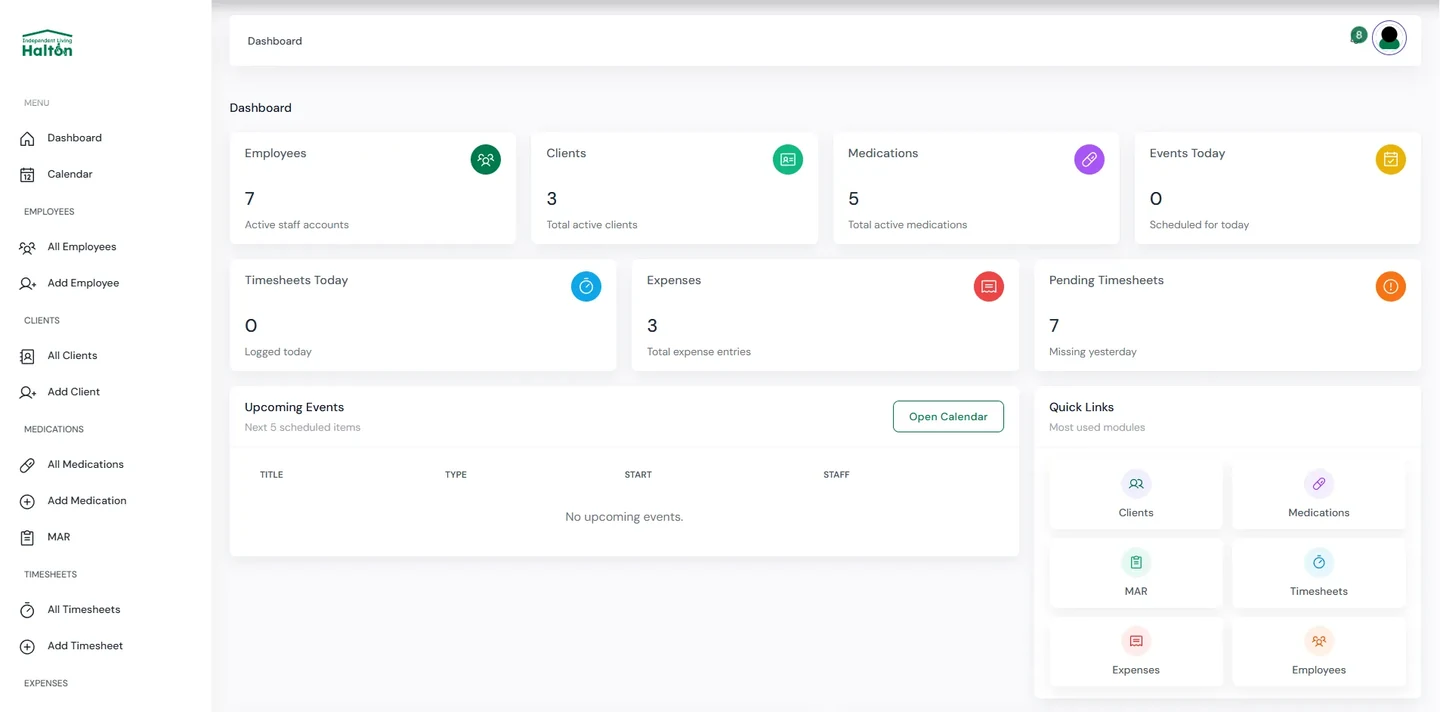
The system brings medication sign-offs, staff schedules, timesheets, expenses and claims into one workflow. Staff can record activity against client and schedule information, while administrators can use role-based calendars, audit records and reports generated from entered data. The system's recorded scope includes 60 clients, 80 medication schedules, 71 scheduled events, 52 timesheets and 148 audit entries. These counts show system usage, not a measured reduction in admin time or care incidents.
What the client gained
We can keep medication sign-offs, schedules and timesheets together, which makes records easier for our team to follow. Reports use information staff have already entered, so we have less paper to gather when preparing them.
We can keep medication sign-offs, schedules and timesheets together, which makes the records easier for our team to follow. Reports use information staff have already entered.
CEO, Independent Living Halton
Screenshots are taken from an anonymised copy of the system. No real client data is shown.